
AMR vs AGV: Key Differences Explained
Overview of AMR and AGV
Warehouse automation has evolved rapidly over the past decade. AMR (Autonomous Mobile Robots) and AGV (Automated Guided Vehicles) have become two core technologies widely used in warehouses, factories, and distribution centers to improve material handling efficiency.
Although both solutions are designed to automate internal logistics, they differ significantly in navigation methods, flexibility, system architecture, and adaptability to changing environments.
From a system integrator and manufacturer perspective, selecting the right mobile robot technology directly impacts deployment speed, scalability, and total cost of ownership (TCO).
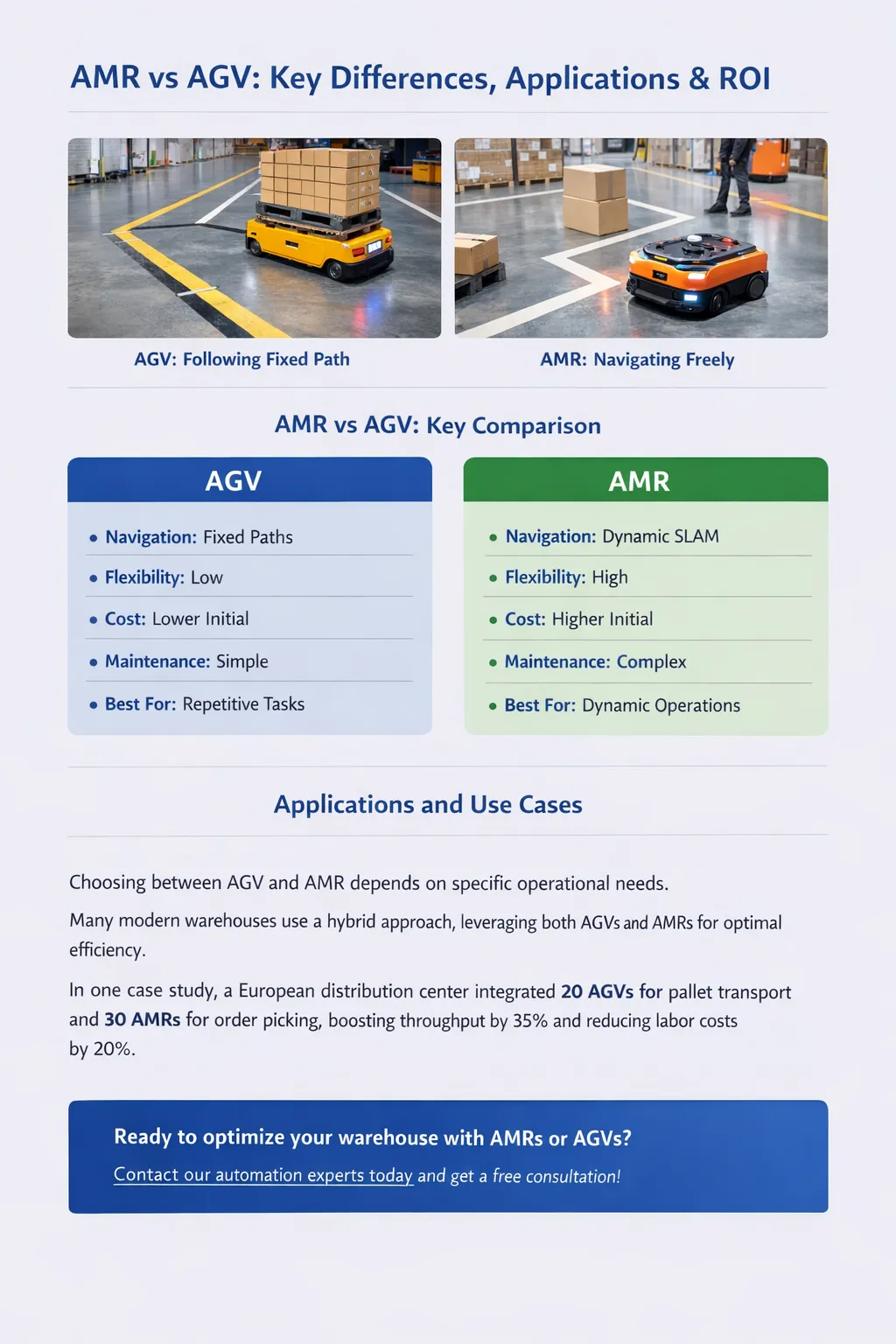
AMR vs AGV Warehouse Navigation Comparison
Visual comparison: AGVs follow fixed and predefined paths, while AMRs navigate freely using SLAM-based autonomous navigation, dynamically avoiding obstacles and adjusting routes in real time.
AGV: Automated Guided Vehicle
Navigation and Technology
AGVs operate by following predefined routes using magnetic strips, embedded wires, or optical markers. This approach ensures high accuracy and predictable movement, making AGVs suitable for repetitive and standardized workflows.
Magnetic tape or wire guidance
Optical markers or QR code navigation
Laser-guided navigation for high-precision applications
Common Applications
Assembly line material transport
Bulk pallet movement in distribution centers
Highly standardized production environments
Limitations
AGVs offer limited flexibility. Any layout change typically requires physical modification of guide paths, resulting in downtime and additional cost.
From practical deployment experience, AGVs are most effective when process flows remain stable over long periods and predictability is prioritized.
AMR: Autonomous Mobile Robot
Navigation and Technology
AMRs utilize sensors, cameras, LiDAR, and SLAM (Simultaneous Localization and Mapping) technology to navigate autonomously without fixed infrastructure.
Dynamic route planning
Real-time obstacle detection and avoidance
Integration with WMS and MES systems
Applications
Flexible warehouse material handling
E-commerce order picking
Factories with changing layouts
Human-robot collaborative environments
Advantages
AMRs provide superior flexibility and scalability. In many customer projects, AMRs significantly reduce implementation time and allow system expansion with minimal disruption.
Applications and Use Cases
The choice between AGV and AMR depends on operational requirements:
AGV: Ideal for repetitive tasks with fixed routes
AMR: Best for dynamic environments requiring flexibility
Case Example
A European distribution center deployed 20 AGVs for pallet transport and 30 AMRs for order picking, increasing throughput by 35% and reducing labor costs by 20%. This hybrid deployment is increasingly adopted by logistics operators seeking both stability and flexibility.
Advantages & Disadvantages
AGV
Pros: High accuracy, stable operation, low software complexity
Cons: Infrastructure-dependent, limited flexibility
AMR
Pros: Flexible, autonomous, scalable, easy system integration
Cons: Higher initial investment, complex sensors and software
FAQ: Common Questions about AMR and AGV
Which technology is better for small warehouses?
AMRs are generally better suited for small and medium-sized warehouses due to flexible navigation and minimal infrastructure requirements.
Can AGVs and AMRs work together?
Yes. Hybrid systems combining AGVs and AMRs are widely adopted in modern warehouses.
What is the ROI difference?
AGVs have lower upfront cost but higher modification cost. AMRs offer better long-term ROI in dynamic environments.
How do AMRs handle obstacles?
AMRs detect obstacles in real time using sensors and SLAM algorithms and adjust routes automatically.
Future Trends in Warehouse Automation
Future automation will focus on intelligent fleet coordination, data-driven optimization, and hybrid AMR + AGV architectures. Companies adopting scalable solutions today will be better positioned for long-term growth.