
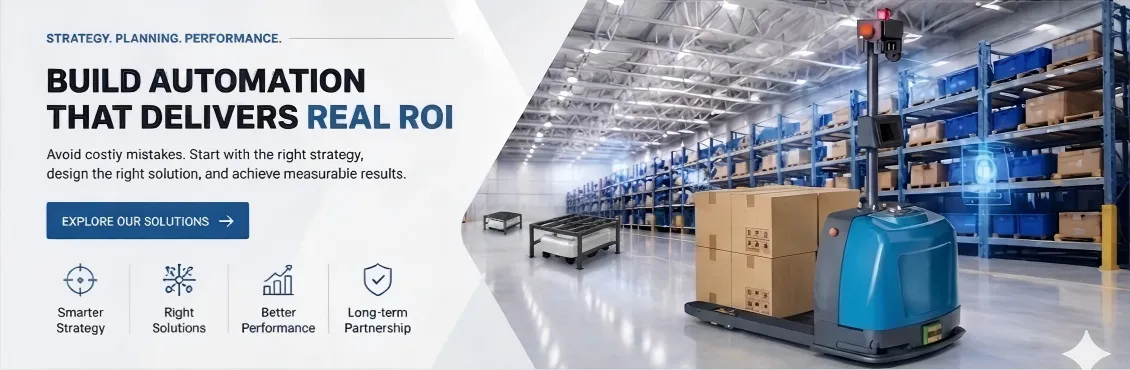
Why Warehouse Automation Projects Fail — Before They Even Start
Not every warehouse automation project fails in a dramatic way.
In fact, most of them don’t fail at all — at least not on paper. The system goes live. The robots are running. Everything looks fine.
But a few months later, the results aren’t what anyone expected. Efficiency gains are limited. Costs are higher than planned. And the return on investment never really shows up.
After being involved in multiple warehouse automation projects across logistics and manufacturing, one thing becomes clear:
Most problems start long before the first robot is deployed.
1. No One Really Owns the Project
Automation projects often sit between operations, IT, and management. Everyone is involved, but no one is fully responsible.
When that happens, decisions slow down, small issues pile up, and performance never gets properly optimized.
A strong warehouse automation strategy needs a clear internal owner — someone accountable from planning to execution.
2. Starting with Robots Instead of the Workflow
One of the most common questions companies ask is:
“Which robot should we choose?”
It sounds reasonable, but it’s the wrong place to start.
Successful warehouse automation doesn’t begin with equipment. It begins with understanding your workflow:
Where are the real bottlenecks?
Which tasks are repetitive and time-consuming?
What actually limits throughput today?
Only after that should you think about solutions like warehouse automation systems and AMRs.
3. Integration Is More Complicated Than Expected
Robots don’t work in isolation. They need to connect with your existing systems — WMS, ERP, and sometimes older equipment.
This is where many warehouse automation projects run into trouble.
Integration takes time, planning, and coordination. If it’s underestimated, it quickly turns into delays and unexpected costs.
4. ROI Expectations Are Too Aggressive
It’s easy to assume automation will deliver quick results. But in reality, it takes time to see the full impact.
Teams need to adapt. Processes need adjustment. Data needs to be analyzed.
That’s why many successful companies start with a small pilot before scaling. It’s the most reliable way to improve warehouse automation ROI without unnecessary risk.
5. Choosing a Vendor Instead of a Long-Term Partner
Automation is not just a purchase — it’s a long-term change in how your operation runs.
Choosing based only on price or specifications often leads to problems later.
What really makes a difference is working with a partner who understands your business and stays involved after deployment.
Final Thoughts
When a warehouse automation project underperforms, the issue is rarely the technology itself.
More often, it comes down to planning, alignment, and expectations.
Getting these right from the beginning is what separates a system that simply runs… from one that actually delivers results.
Frequently Asked Questions
Why do warehouse automation projects fail?
Most projects underperform due to unclear ownership, poor planning, and unrealistic expectations — not because of the technology itself.
How can I improve warehouse automation ROI?
Start with a pilot project, focus on optimizing workflows, and scale gradually based on real performance data.
Is warehouse automation suitable for small or mid-sized operations?
Yes. With the right strategy and phased approach, automation can deliver strong value even in smaller warehouse environments.
Thinking About Automation?
If you're exploring automation or trying to improve an existing system, it helps to step back and look at the bigger picture before making decisions.
Feel free to reach out — happy to share insights based on real project experience.