A Complete Guide for Warehouse Automation
Learn more about our Autonomous Mobile Robots and AGV solutions designed for modern warehouse automation and intralogistics operations.
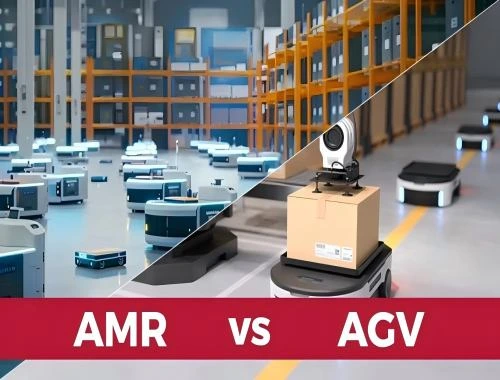
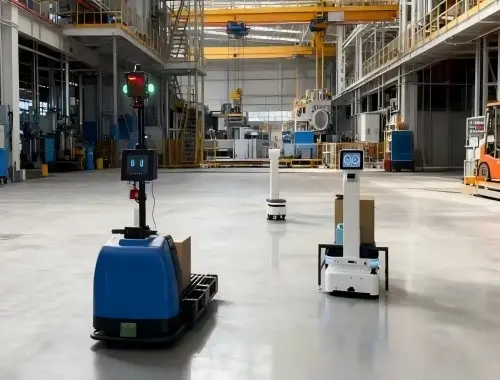
As warehouse automation continues to advance, companies across manufacturing, logistics, and distribution are re-evaluating how materials move inside their facilities. Automated Guided Vehicles (AGVs) and Autonomous Mobile Robots (AMRs) are two of the most widely adopted technologies in intralogistics robotics.
Although AGVs and AMRs are often discussed together, their navigation technologies, flexibility, and operational value differ significantly. Understanding these differences is essential for decision-makers planning scalable and cost-effective automation systems.
In This Guide
AGV vs AMR: Key Differences
Navigation Technologies Explained
Warehouse Automation Use Cases
Cost, ROI, and Scalability
How to Choose Between AGV and AMR
Related AGV & AMR Guides
Overview of AGV and AMR
What Is an AGV?
An Automated Guided Vehicle (AGV) is a mobile robot that transports materials along predefined routes using physical or virtual guidance systems such as magnetic tape, embedded wires, or laser reflectors.
AGVs are commonly used for pallet transport and production line feeding. See how our pallet handling automation solutions are deployed in structured industrial environments.
Typical AGV applications include automotive assembly, food and beverage production, and cold storage logistics where workflows remain stable over time.
What Is an AMR?
An Autonomous Mobile Robot (AMR) navigates independently by understanding and interpreting its surroundings in real time. Instead of following fixed routes, AMRs determine optimal paths dynamically.
AMRs are widely adopted in flexible warehouse environments. Explore our warehouse automation solutions designed for dynamic intralogistics and mixed human-robot operations.
AMRs are especially effective in e-commerce fulfillment centers, retail distribution hubs, and third-party logistics warehouses.
Navigation Principles Explained
AGV Navigation Principles
AGVs rely on guided navigation, meaning movement is restricted to predefined paths.
Magnetic Tape or Wire Guidance – Sensors follow embedded signals along fixed routes
Laser Navigation – Laser scanners detect reflective markers to calculate position
Vision-Based Guidance – Cameras identify floor markings or QR codes
Operational limitation: AGVs cannot autonomously reroute. If a path is blocked, the vehicle stops until the obstruction is removed.
For facilities evaluating AGVs in larger material flow systems, our engineers provide intralogistics system design tailored to layout and throughput requirements.
AMR Navigation Principles
AMRs use autonomous navigation based on real-time perception and decision-making.
LiDAR and SLAM – Continuous mapping and localization
Dynamic Path Planning – Automatic rerouting around obstacles
Multi-Sensor Detection – Safe navigation among people and equipment
AMRs adapt to environmental changes without physical modifications, making them suitable for evolving warehouse operations.
AGV vs AMR Comparison in Warehouse Automation
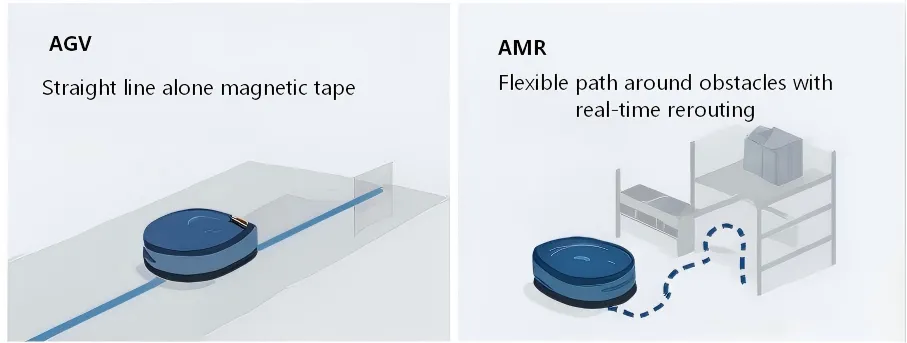
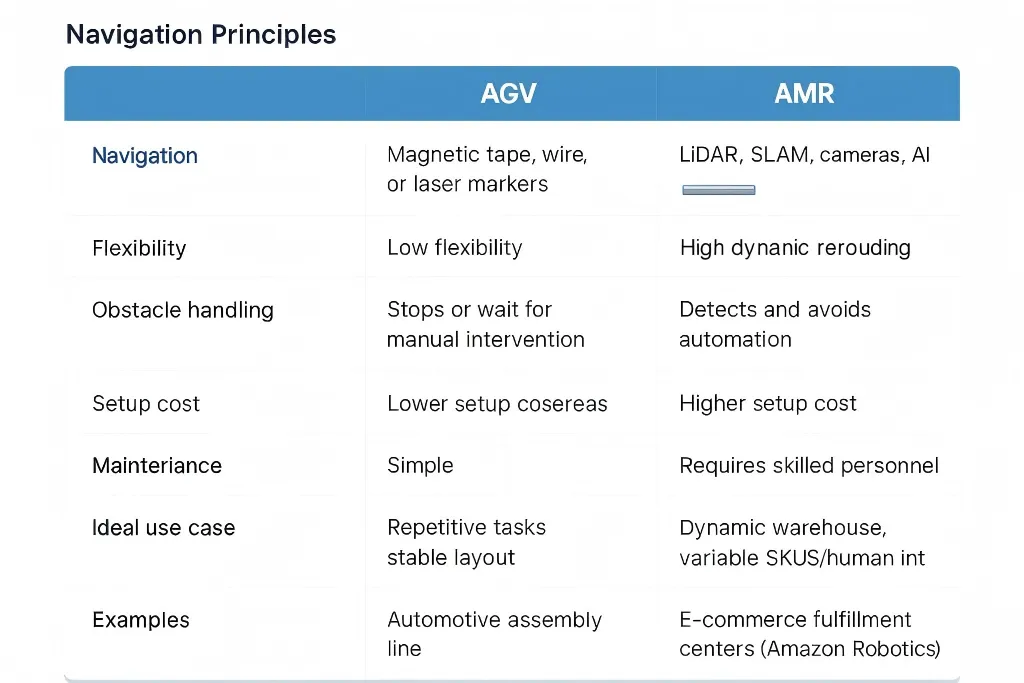
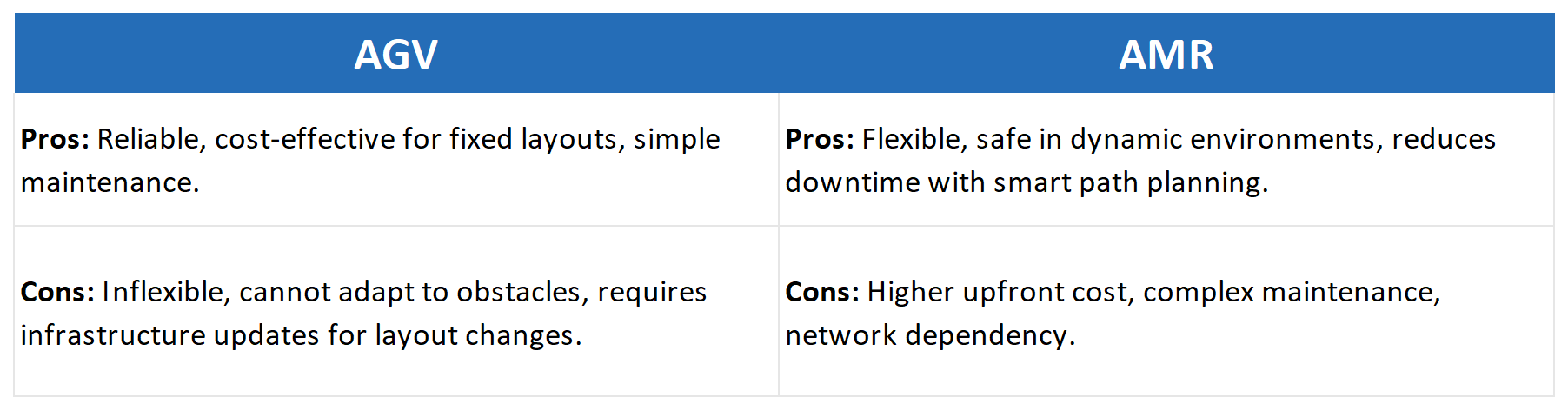
For a deeper evaluation based on real operating conditions, review our intralogistics automation solutions tailored to warehouse performance goals.
Cost, ROI, and Long-Term Scalability
When comparing AGV vs AMR, cost should be evaluated beyond initial investment.
AGVs often require lower upfront costs but incur higher expenses when layouts change due to infrastructure modifications. AMRs typically involve higher initial investment, yet offer lower long-term costs by reducing reconfiguration, downtime, and scalability barriers.
In projects focused on long-term growth and flexibility, AMRs often deliver faster ROI through improved throughput and reduced operational disruption.
Best Use Cases for Each Technology
Ideal AGV Use Cases
Automotive assembly lines
Food and beverage production
Cold storage warehouses
Heavy-load pallet transport
Ideal AMR Use Cases
E-commerce fulfillment centers
Retail distribution hubs
3PL warehouses
Facilities with frequent layout changes
View real-world deployments in our warehouse automation case studies, including AGV and AMR projects across manufacturing and logistics facilities.
How to Choose Between AGV and AMR
Layout Stability – Fixed layouts favor AGVs; dynamic layouts favor AMRs
Human Interaction – High interaction requires AMR safety capabilities
Scalability – AMRs support future expansion more easily
Total Cost of Ownership (TCO) – Consider long-term modification costs
In many modern warehouses, a hybrid approach combining AGVs and AMRs provides the best balance of efficiency and flexibility.
Industry Experience
Based on experience delivering AGV and AMR systems across manufacturing and warehouse environments, successful automation projects depend on aligning robot navigation capabilities with real operational workflows—not simply adopting the most advanced technology.
Need Help Choosing the Right Solution?
Selecting between AGV and AMR is not always straightforward.
Our engineers can evaluate your layout and operational goals. You can also explore our AMR product range and AGV systems to better understand available options.
Related AGV & AMR Guides
FAQ: AGV vs AMR Navigation
Is AMR better than AGV?
AMRs are better for dynamic environments, while AGVs remain effective for stable, repetitive workflows.
Do AGVs require physical infrastructure?
Yes. Most AGVs rely on magnetic tape, wires, or laser reflectors.
Can AMRs work safely with humans?
Yes. AMRs are designed for shared environments and use real-time obstacle detection.
Which has a lower total cost of ownership?
AGVs often have lower upfront costs, while AMRs offer better long-term flexibility.
For a deeper technical overview, visit our intralogistics robotics guide.
About the Author / Company
This article is written by the automation engineering team of a professional manufacturer and solution provider specializing in AGVs, AMRs, and intralogistics robotics. The team supports global customers with system design, deployment, and long-term optimization.