As global supply chains accelerate, warehouse operations are facing daunting challenges such as surging order volumes, rising labor costs, and high employee turnover. Logistics managers now stand at a crossroads: choose human labor or Autonomous Mobile Robots (AMRs)? This decision can make or break a company’s competitiveness. This article dives deep into four critical dimensions—deployment flexibility, cost structure, operational efficiency, and return on investment (ROI)—to dissect the core differences between the two.
Deployment Flexibility: Rapid Response vs. Training Costs
Human teams are often considered “flexible” because new hires are thought to be able to step into basic roles with little ramp-up time. However, this assumption doesn’t always hold true in practice.
In reality, it usually takes 3–6 months to fully train a skilled worker. When warehouse layouts change or SKUs increase, retraining can be time-consuming and labor-intensive.
During peak sales seasons like e-commerce promotions, the efficiency of temporary workers can drop by 20–30% compared to experienced staff.
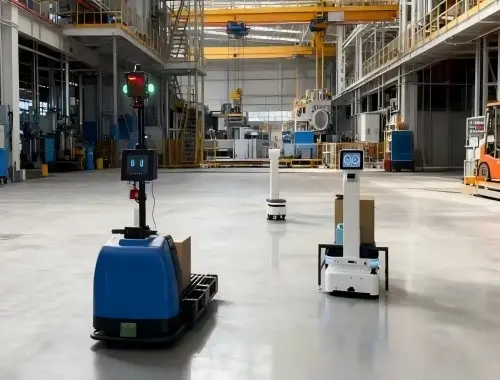
In contrast, AMRs offer plug-and-play advantages. With laser navigation or visual recognition technology, modern AMRs can map a new warehouse in just a few hours.
AMRs adapt to layout changes through simple software updates, eliminating the need to install tracks or rebuild floors.
For example, when a fast-moving consumer goods warehouse added 500 new SKUs, the AMRs instantly recalculated and optimized their routes via system commands.
In contrast, a human team needed 1–2 weeks to adjust to the new workflow.
Cost Structure: Fixed Spending vs. Long-Term Control
From a short-term view, human labor may appear cheaper—with monthly wages, insurance, and benefits forming the bulk of expenses.
Yet hidden costs can account for as much as 30%, including recruitment, training losses, injury compensations, and productivity fluctuations.
In regions like North America and Europe, the average annual cost of a warehouse worker ranges from $40,000 to $60,000, increasing by 3–5% annually.
AMRs, on the other hand, have a different cost profile. The upfront investment is higher—each unit typically costs $20,000 to $50,000—but ongoing costs are relatively low. Aside from $500–$1,000 in annual maintenance, AMRs don’t take vacations, don’t get tired, and don’t quit. For large
Operational Efficiency: Stability vs. Volatility
Human performance is affected by physical fatigue, emotions, and experience. Studies show that after four consecutive hours of work, order picking accuracy drops by 15–20%. AMRs, by contrast, maintain a 99.9% accuracy rate 24/7.
In extreme environments like cold-chain warehouses, AMRs truly shine—they can operate in -20°C without special gear, whereas human teams suffer a 50% efficiency loss due to shift rotations and physical constraints.
AMRs also offer valuable data-driven insights for operational optimization. By tracking travel paths, stop times, and task durations, the system dynamically reallocates tasks. One e-commerce warehouse that deployed AMRs saw order processing times cut from 4 hours to 1.5 hours, with throughput during peak times doubling.
Return on Investment: Short-Term vs. Long-Term Value
For small and mid-sized warehouses processing fewer than 5,000 orders per day, human labor may offer a higher ROI due to low upfront investment and reduced financial pressure. But for larger warehouses, AMR payback periods are shrinking.
The industry average ROI is now 2–3 years, with some high-efficiency cases (like pharmaceutical cold chains) achieving ROI in as little as 18 months.
More importantly, AMRs are capital assets that appreciate in value over time. With continuous software upgrades, older units can remain in service longer. Human labor costs, by contrast, are rigid and irreversible.
For instance, a logistics giant invested $10 million in AMRs in 2023 and saved $6 million in labor costs the following year. Their projected 5-year ROI reached an impressive 280%.
Conclusion
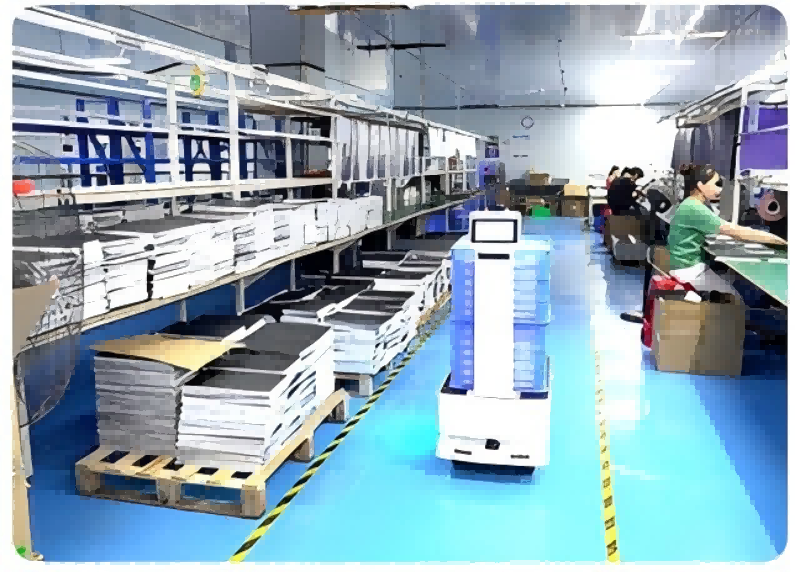
AMRs are not here to replace humans entirely—they’re redefining human-robot collaboration. Robots handle repetitive transport tasks, while workers focus on high-value activities like quality inspection and exception handling. When choosing between human labor and AMRs, businesses should consider warehouse size, order variability, and long-term strategic goals. Small warehouses may start with pilot AMR programs, while large facilities can move toward full automation.
In this fierce race for warehouse efficiency, only the most adaptable players will lead the pack.
Which model fits your warehouse better? Share your thoughts.